The scenario: Northwind Outfitters

Every design decision in this repo came from somewhere. This is the somewhere.
Why this matters
A support queue is the place where a company finds out it hurt someone.
Not every ticket, obviously. Most of them are a late package or a wrong size. But the injury report, the allergic reaction, the tent pole that collapsed on a car, the customer whose fourth message finally says "I've had it" — those arrive in the same inbox as "do you ship to Canada," written in the same tone, often with the same subject line. Somebody has to notice.
You can try this yourself. The inbound queue shows twenty real tickets as an agent sees them, unsorted. One is a parent reporting that their child got sick. See how long it takes you to find it.
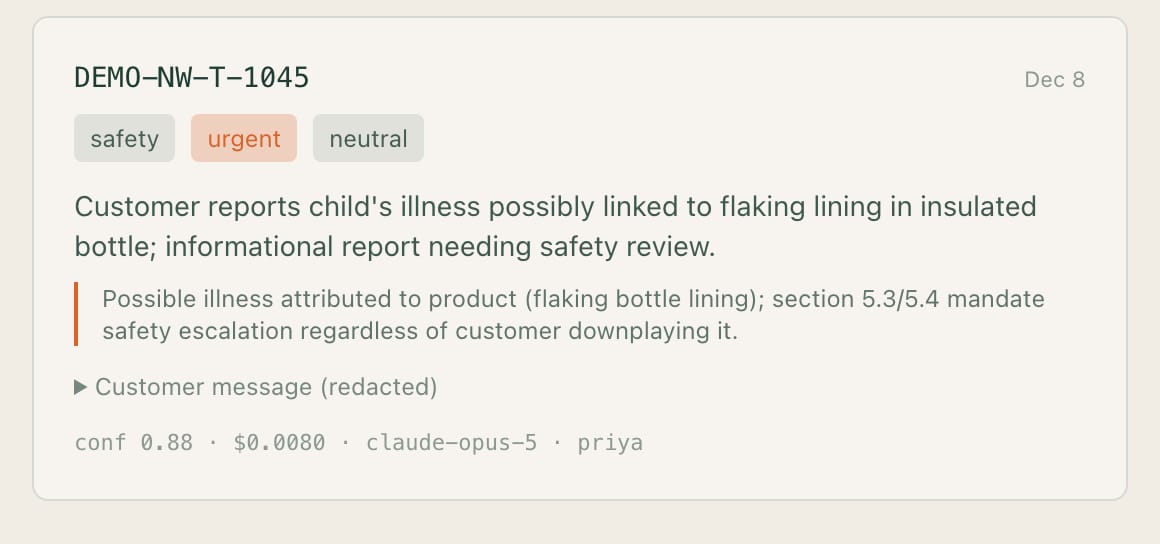
Right now that somebody is a human reading 4,100 messages a week, and in December it is a seasonal hire on their fifth day who has not read the policy handbook. This is not a story about saving 90 seconds per ticket. It is a story about a three-day gap between a child's urgent care visit and anyone at the company knowing it happened.
That is the stake. Everything in this repo — the schema, the calibrated confidence score, the tool trace, the eval set — is an attempt to make sure the one message that matters does not sit in a queue for three days because it opened with "probably nothing."
The techniques are ordinary. Structured outputs, tool use, streaming, caching. You will use them for something less consequential and they will still be the same techniques. But the reason to get them right — to calibrate the confidence score, to return the trace, to write the gold case you know will fail — only shows up when the cost of being wrong is a person rather than a metric.
Read this page before Lab 1. Most of the questions the labs ask ("why is this escalation urgent?", "why cap the refund here?", "why does the trace matter?") have obvious answers once you know the company, and no answer at all without it.
The company
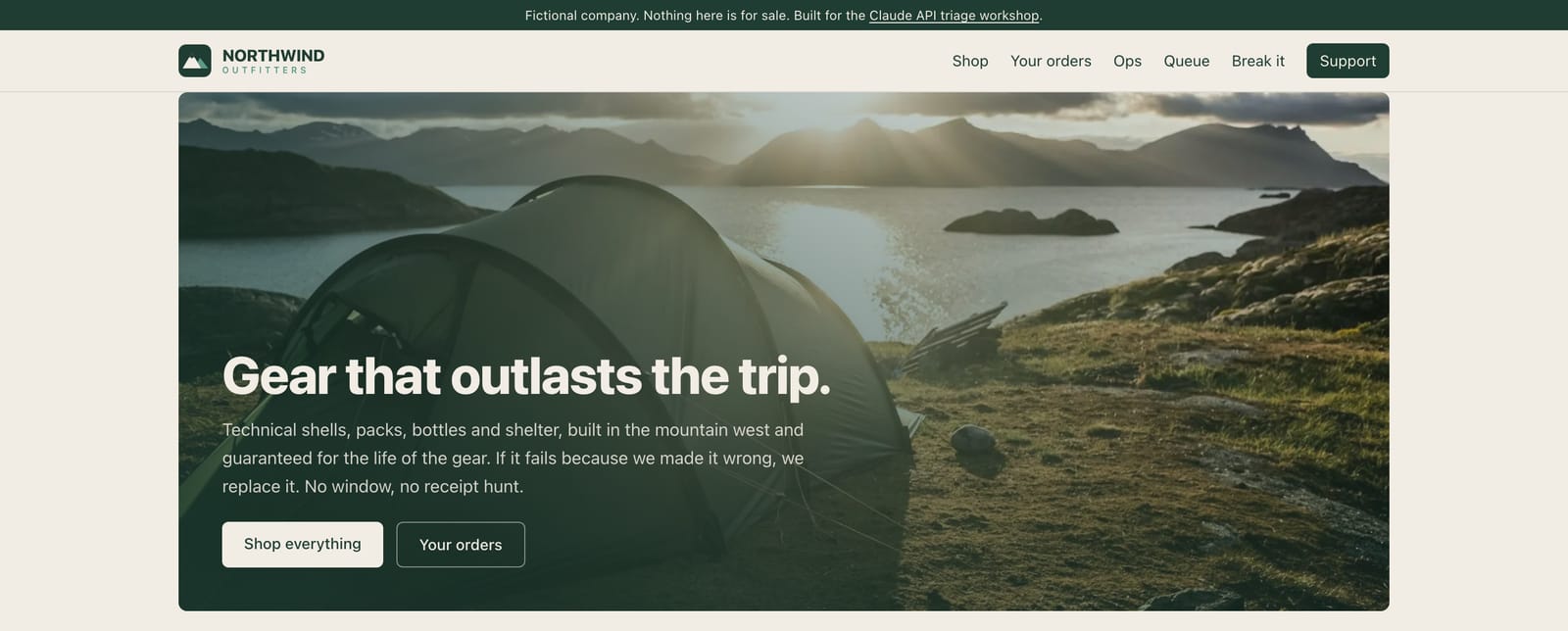
You can visit them. northwind.mlynn.dev is a working storefront: the catalog, the warranty terms, a fake order history, and a support form that runs the real triage service on whatever you type into it. Everything below is easier to hold once you have looked at the price tag on a jacket you are about to complain about.
Northwind Outfitters sells outdoor gear. Technical shells, packs, insulated bottles, tents. Roughly $180M a year, about 78% of it direct to consumer through the website and the rest through twelve retail stores in the mountain west.
The business is violently seasonal. A quiet Tuesday in April looks nothing like the second week of December, and the support team is sized for neither.
They sell on a lifetime workmanship guarantee. Commercially that is the single most important fact about them. It is why customers pay $189 for a shell jacket, it makes their support costs structurally higher than their competitors', and it is why "just deny the claim" is never the right answer, even on an eight-year-old claim.
The support organization
34 agents. Two supervisors. One director, Priya Raman, who owns the numbers.
| Average week | Peak week (Nov–Dec) | |
|---|---|---|
| Inbound tickets | 4,100 | 11,300 |
| Agents on shift | 34 | 46 (12 seasonal) |
| Median first response | 14 hrs | 41 hrs |
Channel mix is 62% email, 31% chat, 7% phone transcripts that get typed up after the call. All three land in one queue.
Volume nearly triples at peak and headcount grows by a third, and the twelve seasonal hires have not read the policy handbook. So in December, the people handling the most tickets know the least about the rules.
What is actually broken
Triage is manual and it is the bottleneck.
Every inbound message is read by an agent, categorized by hand, and dropped into one of seven queues. That first read takes 90 seconds to four minutes and produces no value for the customer. It is pure routing overhead, and it happens 4,100 times a week.
They tried to automate it twice.
Keyword rules, 2023. A regex layer that routed on terms like "refund", "broken", "where is". It is still running and it is right about 61% of the time. It fails in the ways keyword systems always fail. "This jacket is broken" routes to product defects correctly. "I'm broken up about how long this is taking" also routes to product defects. Nobody trusts it, so agents re-triage everything anyway and the rules layer is now decoration.
An off-the-shelf classifier, 2024. Better accuracy, around 84%, and it was abandoned inside a quarter for a reason that matters more than the number: it could not explain itself. When it routed a safety report to billing, nobody could say why, and there was no way to fix that one case without retraining. Priya killed it after the second audit finding.
So the bar this project has to clear is not really about accuracy at all. Classify the ticket so a supervisor can audit the decision and an engineer can correct it on a Tuesday afternoon.
The incident
In October 2025 a customer wrote in about an insulated bottle. The liner had degraded and their daughter had an allergic reaction to something in the water, serious enough for an urgent care visit.
The message opened with "Hi, probably nothing, but..."
It sat in the general queue for three days. The keyword layer saw no defect words. The agent who eventually picked it up handled it well, but by then the company had a three-day gap between a reported injury and anyone at Northwind knowing about it. Legal found out from the customer's attorney.
Handbook version 4.2, effective January 2026, is the direct result. It added section 5.4: safety reports reach the safety queue within one hour, no exceptions, even if the customer says it is not a big deal. That last clause is in the handbook because of the phrase "probably nothing."
So safety sits apart from the other labels in CategoryEnum. A false negative
there is unacceptable and a false positive costs almost nothing. When you get
to Lab 6 and see eval-04 and the
casually-worded safety case in Step 3, you are looking at this incident encoded
as a test.
Why the money rules exist
The $200 agent refund ceiling (clause 2.7) came from a 2024 case where an agent, trying to save an angry customer, refunded $4,800 across six transactions over two days. No malice, no policy at the time, and the customer was genuinely upset. The ceiling exists so that a single agent under pressure cannot make a decision that size alone, and the anti-splitting language exists because the first version of the rule was trivially routed around.
The 5–7 business day refund language (clause 2.3) exists because agents kept promising "today" and customers kept escalating on day two when the money had not appeared. The refund was always fine. The promise was the problem.
Clause 6.3, no goodwill discounts before the problem is fixed, came from survey data. Customers offered a discount code before a resolution rated the interaction lower than customers offered nothing at all. It reads as being paid to go away.
Every one of these is the shape support policy takes at a company that has been
doing this long enough. That is why the resolution agent in /v1/resolve reads
policy instead of reasoning from first principles about what seems fair.
The brief
What Priya asked engineering for, in her words, reconstructed from the doc that started this project:
Read the message. Tell me what it is, how urgent it is, and whether a human needs to touch it. Show me why you decided that. Do not tell me you are 95% sure when you are guessing.
Those four sentences map one to one onto the routes in this repo.
| Her requirement | What it became |
|---|---|
| "Tell me what it is" | POST /v1/triage, a validated classification |
| "Show me why you decided that" | the tool trace on POST /v1/resolve |
| "Whether a human needs to touch it" | requires_human plus escalation rules |
| "Do not tell me you are 95% sure when you are guessing" | the calibrated confidence field |
That last one is the requirement everybody skips. It is also the one that
killed the 2024 classifier, and it is why confidence in TriageSchema carries
an explicit calibration instruction rather than a bare z.number().
Constraints
These are the non-negotiables the design had to live inside.
Budget. Priya has roughly $4,000 a month for this. There is an interactive model of this if you would rather move the numbers than read them. At peak that is about 45,000 tickets, which is a hair under nine cents per ticket end to end. The cached prefix — role instructions plus the full handbook — measures about 3,400 tokens, and it goes out on every request, so without prompt caching that prefix alone would eat the entire budget. Lab 5 is the difference between this project shipping and not.
Auditability. Every automated decision touching money or safety has to be
reconstructable six months later. This is why /v1/resolve returns the full
tool trace and why the system prompt prescribes a fixed lookup order. A correct
answer that cannot be explained is what got the last system cancelled.
No autonomous action. The system recommends. It does not issue refunds, it does not send replies unreviewed, and it does not close tickets. Every route here produces a recommendation or a draft that a human approves. That constraint is doing more security work than any prompt instruction, and it is the real answer to the prompt-injection question in Lab 8.
Policy changes weekly. Legal updates the handbook constantly. The system cannot have policy baked into prompts or, worse, into code. It reads the handbook, which is why the handbook is a file and not a paragraph.
How success is measured
Priya reports on four numbers. They are worth knowing because they explain why the labs measure what they measure.
- Time to first response, especially at peak. Triage overhead is the removable part.
- Mis-routing rate. Currently 23%. Every mis-route costs a re-read and a re-queue.
- Safety time-to-queue. Target is one hour and the tolerance is zero.
- Agent-hours on triage. The number she wants to move to zero so those hours go to actually resolving things.
Her dashboard is at northwind.mlynn.dev/ops. The twelve-month history there is invented and labelled as such; the unit economics, the eval accuracy and the category mix are real.
Notice what is not on the list. Nobody is measured on model accuracy. Accuracy is a proxy, and the eval set in this repo exists to keep that proxy honest, not because 91.7% is the goal.
The people you will keep meeting
Priya Raman, Director of Support. Owns the four numbers. Has been burned by an unexplainable system once and will not be again. When a lab asks "what would you tell your PM," she is the PM.
Marco Silva, senior agent, six years. Handles the hard tickets. Knows the handbook better than the handbook does. His actual fear about this project is that it will confidently hand him a wrong recommendation and he will be the one who signed off. Read the draft replies in Lab 4 as though Marco is about to put his name on them.
Dana Kim, customer. Trail Club member since 2023, $3,100 lifetime value,
appears in data/orders.json with a jacket whose zipper separated. She is the
happy path.
The December seasonal hire. No name, twelve of them, started last week, has not read the handbook. The system exists for this person more than anyone.
Where this API sits
Today:
With this service:
The human never leaves the loop. The routing read goes away.
Reading the repo through the story
Every one of these is a thing you will hit in a lab, and the story is the reason it is there.
| In the code | Because |
|---|---|
safety outranks every category | the October 2025 incident |
| "even if the customer says it is not a big deal" | the phrase "probably nothing" |
confidence has a calibration instruction | the 2024 classifier died of false certainty |
/v1/resolve returns a tool trace | the audit findings |
| the handbook is a file, not a prompt | legal changes it weekly |
| prompt caching on the handbook prefix | $4,000 a month against 45,000 peak tickets |
requires_human on every classification | no autonomous action, ever |
within_agent_authority in ResolutionSchema | the $4,800 refund in 2024 |
| the 5–7 day refund language in the drafter | agents promising "today" |
eval-11 is deliberately ambiguous | real tickets are multi-intent and messy |
A note on what is fictional
Northwind Outfitters is invented. The company, the people, the incident, and the numbers are all made up for teaching.
The shapes are not. Manual triage as a bottleneck, a keyword layer nobody trusts, a classifier cancelled for being unexplainable, a refund ceiling written after an expensive afternoon, and a safety rule written after a bad one, are what support organizations actually look like. If you are porting this to your own domain, the exercise is to write down the real story you already have, and then check whether your schema, your tools, and your gold set reflect it.
Most of the time they do not, and that gap is the actual work.